Showing posts with label Architecture. Show all posts
Sunday, 4 March 2012
Tate Modern - Brand Location
Branding is not just a nice logo and good advertising. The brand reflects the personality of an organization with everything that is part of it: products, services, employees, history, customers, advertising, packaging, logo design,... and location. The attention location received as part of the brand image, is a rather new phenomenon and was probably first explored by luxury brands. They found each other all over the world in certain places, streets or avenues. Good examples are the Champs-Élysées in Paris, New Bond Street in London, Bahnhofstrasse in Zurich, the Fifth Avenue in New York or The Bund in Shanghai.
However, also technology brands recognized the potential of prominent locations with Apple once more leading this development. Sport brands started to build their own shops, like Nike, Adidas, Puma and are not happy anymore to be simply sold by department stores. Even M&M's has its own store, one that all the tourists find very easily when visiting London with its amazing location at Leicester Square and spread over 4 floors.
In all the countries I have been so far, I always visited a Starbucks. It has somehow changed, since Starbucks opened so many stores, but in the beginning of their launch in countries around the world, they always rented very beautiful buildings at very attractive locations. For me this was part of the Starbucks brand experience. You drank a good coffee, were served by lovely staff and had a very nice painted ceiling or a stunning view out of the window. The quality of the Starbucks locations has decreased dramatically since they started to grow so quickly, which is a pity, but not really part of the topic I want to cover now...
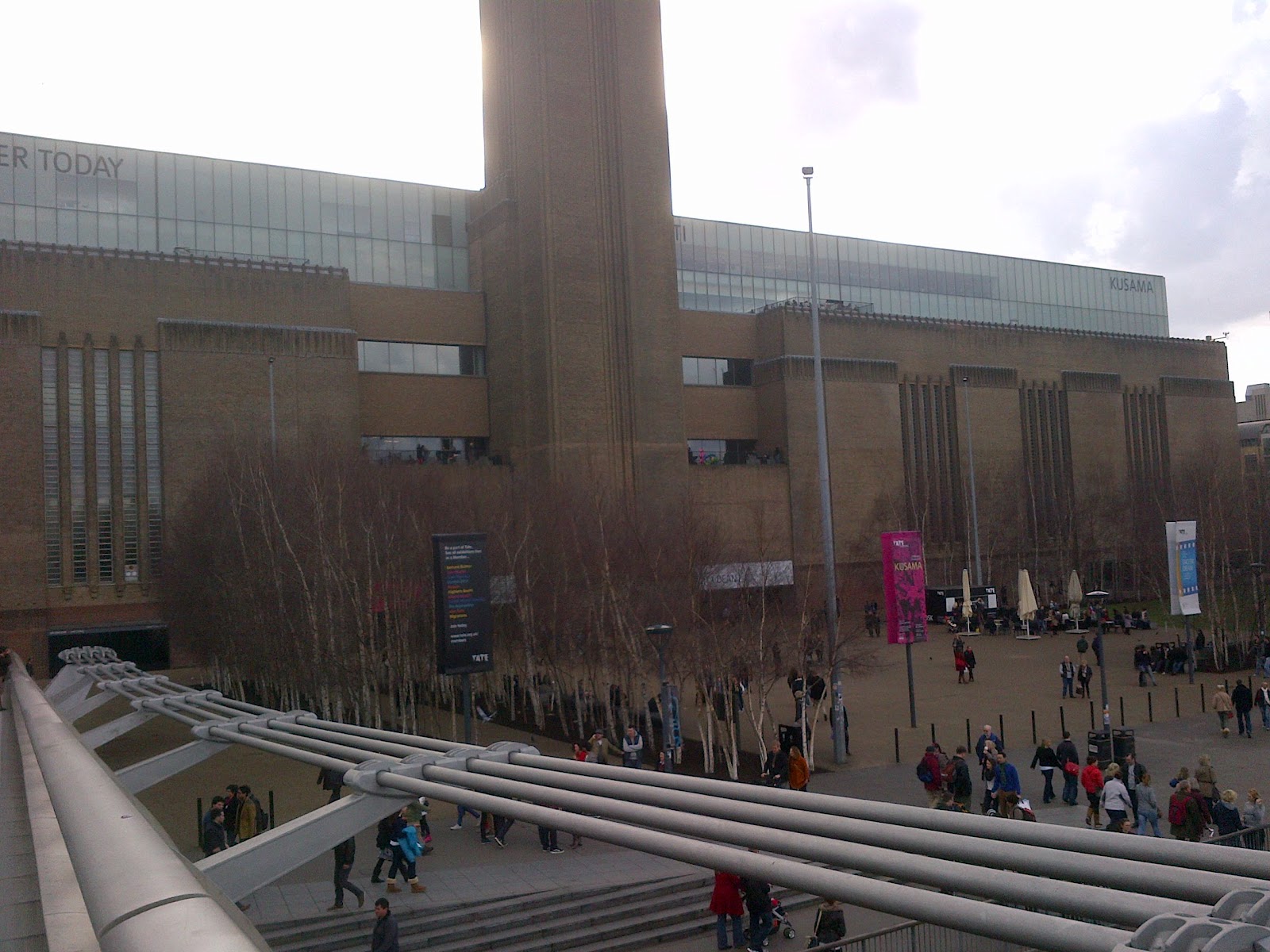
Tate Modern has one of the most beautiful locations in London. The Swiss architects Herzog & de Meuron transformed the Bankside Power Station into Tate Modern and the museum receives now 5 million visitors every year. In the same year Foster & Partners built the Millennium Bridge, which now connects St Paul's Cathedral and Tate Modern and is a very beautiful walk with amazing views of the City, Tower Bridge and of course the Thames. Tate Modern can also be approached from both sides along the Thames either from Tower Bridge or from London Eye and Southbank. Two walks I would strongly recommend to everybody visiting London.
The building itself is very impressive and the architects managed to keep the character of the old power station, but make it a place where the paintings and sculptures come into their own. The Turbine Hall was left as a huge hall, which can be used for large installations, maybe also laid out with 100 million porcelain sunflower seeds (a project by Ai Weiwei) or it is just taken over by visitors which sit down or walk around and enjoy the architectural masterpiece.
Tate Modern's location has definitely also an impact to make it the world's most visited museum for modern art. It is just such a good experience to come here and after you have been once in Tate Modern you want to come again and again. From every floor you have a stunning view on St Paul's Cathedral, the most beautiful one in the restaurant on the top floor.
The open space makes the art also more accessible for the visitors and walking through the rooms you get the feeling that people start a communication with the pieces exhibited in Tate Modern. I have visited a lot of museums in different cities around the world and Tate Modern is one of the most beautiful one, where the art starts to come alive. My favorite one is still Museo Reina Sofia in Madrid, though, with its extension designed by Jean Nouvel.
Saturday, 25 February 2012
HdM and Ai Weiwei will design the Serpentine Gallery Pavilion this Summer
I know I'm always a bit late with the announcements here on red bulb. If you want to get more recent updates it's probably better to follow my twitter account @jbabics.
The decision was made earlier this month by the Serpentine Gallery that the Swiss Architects Herzog & de Meuron and the Chinese artist, architect, curator, publisher, poet and urbanist Ai Weiwei will have the honor to be able to design the gallery's pavilion in Kensington Gardens this summer. I was very pleased to hear that but at the same time also a bit surprised. One of the condition for an architect to be chosen to design the Serpentine Gallery Pavilion is that they have never built anything in the UK before. Herzog & de Meuron have indeed completed a quite distinct project in the UK with converting the Bankside Power Station in London into Tate Modern. However, the pavilion will be the first "collaboration" of HdM and Ai Weiwei in the UK... In 2010 they already used a trick to get Jean Nouvel build the pavilion with the reason that his new shopping center close to St Paul's Cathedral was actually not finished yet. The original idea of the pavilion was probably to give a chance to very talented new architects with potential to become start architects. Since most of the pavilion designers are now stars (e.g. Zaha Hadid, the designer of the first pavilion in 2000) the standard became very high and the building boom in London does not leave so many star architects, which have not built in UK yet.
Anyway, by no means I want to criticise the choice of Hans-Ulrich Obrist, Co-director of the Serpentine Gallery, and his team. I really look forward to seeing the result of HdM and Ai Weiwei's creative minds, which has of course also a connection to the Olympic Games in London. Herzog and de Meuron designed the "Bird's Nest", the National Stadium for the Olympics in Beijing 2008 and Ai Weiwei was integrated in the project very early as their cultural interpreter.
I am sure we will see a very unique approach of the architects to this project. Some first descriptions can be found on www.serpentinegallery.org.
The decision was made earlier this month by the Serpentine Gallery that the Swiss Architects Herzog & de Meuron and the Chinese artist, architect, curator, publisher, poet and urbanist Ai Weiwei will have the honor to be able to design the gallery's pavilion in Kensington Gardens this summer. I was very pleased to hear that but at the same time also a bit surprised. One of the condition for an architect to be chosen to design the Serpentine Gallery Pavilion is that they have never built anything in the UK before. Herzog & de Meuron have indeed completed a quite distinct project in the UK with converting the Bankside Power Station in London into Tate Modern. However, the pavilion will be the first "collaboration" of HdM and Ai Weiwei in the UK... In 2010 they already used a trick to get Jean Nouvel build the pavilion with the reason that his new shopping center close to St Paul's Cathedral was actually not finished yet. The original idea of the pavilion was probably to give a chance to very talented new architects with potential to become start architects. Since most of the pavilion designers are now stars (e.g. Zaha Hadid, the designer of the first pavilion in 2000) the standard became very high and the building boom in London does not leave so many star architects, which have not built in UK yet.
Anyway, by no means I want to criticise the choice of Hans-Ulrich Obrist, Co-director of the Serpentine Gallery, and his team. I really look forward to seeing the result of HdM and Ai Weiwei's creative minds, which has of course also a connection to the Olympic Games in London. Herzog and de Meuron designed the "Bird's Nest", the National Stadium for the Olympics in Beijing 2008 and Ai Weiwei was integrated in the project very early as their cultural interpreter.
I am sure we will see a very unique approach of the architects to this project. Some first descriptions can be found on www.serpentinegallery.org.
Sunday, 1 January 2012
What happened to the CCTV?
For most of the people CCTV triggers the image of security cameras, but CCTV is also the short form of China Central Television (the Chinese counterpart of BBC) and "the CCTV" is commonly also used as a name for the skyscraper, which was built in Beijing to serve as the broadcasting channel's new headquarters.
The CCTV headquarters was designed by OMA, the architecture office of Rem Koolhaas, and received international recognition for its very unique structure. Together with the Olympic Stadium (the Bird's Nest) by Herzog & de Meuron, Paul Andreu's National Theater of China and the terminal 3 of Beijing’s international airport designed by Foster + Partner it belongs to symbols of the new age of iconic contemporary architecture in China built by famous international architects.
Pictures of the CCTV headquarters can be found in many books about modern architecture, since it is symbolic for a new generation of complex engineering structures, which would not have been possible a decade ago.
The beautiful rendered pictures is what everybody has in mind when they think about the CCTV headquarters, including me when I first visited Beijing last summer. Walking towards the building, the pictures out of the architecture books seem to keep their promise. The 44-storey skyscraper arising in the Beijing Central Business District looks absolutely stunning. However, when I came closer I got more and more the feeling that there is something wrong. The building was officially opened in 2008, but everything looked like it is still in construction. A big fence surrounds the CCTV headquarters and it does not really look like anybody works in there.
Three years ago, in the beginning of 2009 I was in Shanghai during the Chinese New Year and I remember very well the Lantern Festival, which is the last day of the festive season. We received the news that one of the buildings close to the CCTV headquarters was on fire and that there was a huge risk that the skyscraper itself gets damaged as well. The Beijing Mandarin Oriental Hotel, which was in construction and was meant to occupy the building burnt down completely and some people suspected fraud behind the fire, since the hotel business was not at its best during this time. However, the good news was that the CCTV headquarters was undamaged.
Therefore, I did not think anything bad when I planned to visit Koolhaas' skyscraper in Beijing. Lights are on in the building, but it looks rather unoccupied. The building, which burnt down was not completely removed and the whole area still looks like a construction site, although the buildings should have been finished already. So what happened to the CCTV? Google could not give me an answer, descriptions are vague and give rather information about the unique and praised design of the structure than about the current use. Pictures again seem all be rendered and very seldom you'll find a real photograph.
If the Chinese want to keep hidden what happened on the night of the Lantern Festival in 2009, they will probably manage to keep it hidden. I wonder, what happens with the CCTV headquarters. It would be a real shame, if the building is never going to be used. Hopefully the site looks different the next time I'll be in Beijing...
Subscribe to:
Posts (Atom)


